
Research
Value-based decision-making
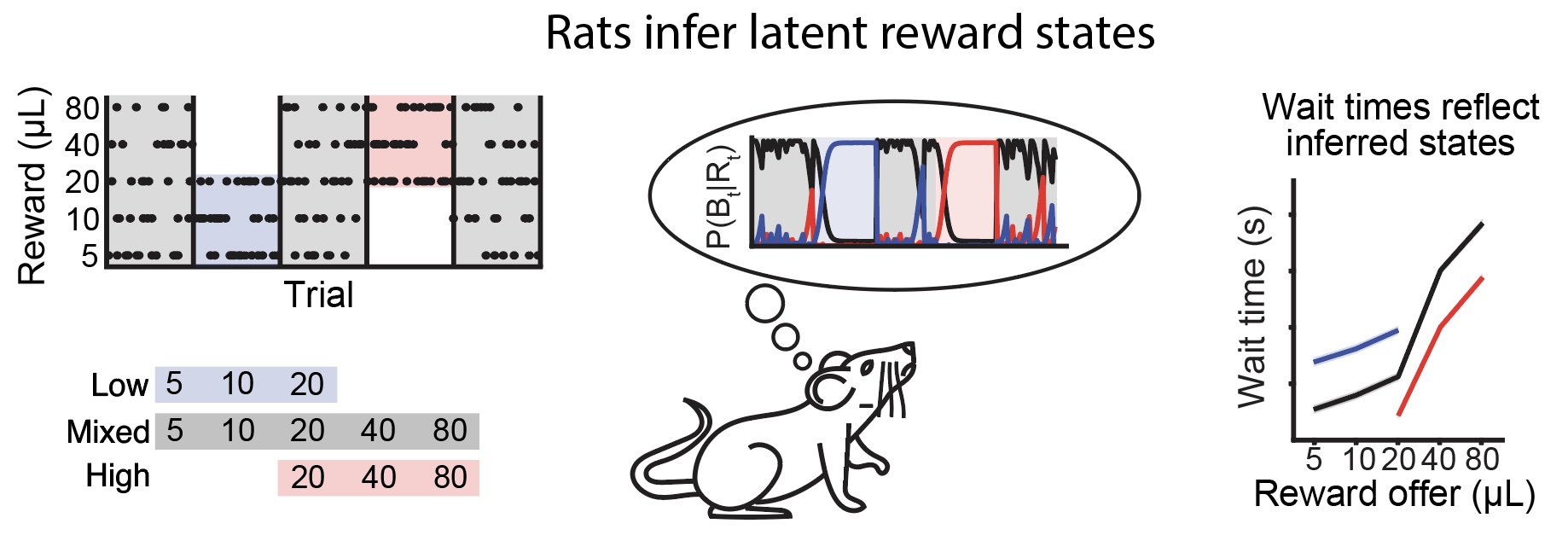
Our lab studies rats performing a value-based decision-making task (the “temporal wagering task”) in which they reveal how much they value different rewards by how long they are willing to wait for them. The task includes hidden reward states, or blocks of trials offering different distributions of rewards, and expert rats infer the hidden state when deciding how long to wait. Because many cognitive variables are latent (i.e. internal to the animal), we use well-validated computational models of behavior to relate internal variables to neural signals and behavior. We seek to uncover the granular circuit mechanisms that support complex cognitive computations in the temporal wagering task. Our commitment to a single paradigm is meant to enable deep understanding across many projects, and implicitly induces replication of past results. The task is a vehicle for addressing outstanding questions in systems neuroscience, for instance, how neural signals from the frontal cortex are read out by downstream circuits.
Rats also adjust how quickly they initiate trials based on the hidden states, and that action reflects a reinforcement learning process that relies on dopamine in the nucleus accumbens, among other neural substrates. Projects that focus on rats’ trial initiation times (as opposed to wait times) investigate the neural mechanisms of reinforcement learning. We are interested in understanding why different algorithms support trial initiation times (reinforcement learning) and wait times (hidden state inference).